

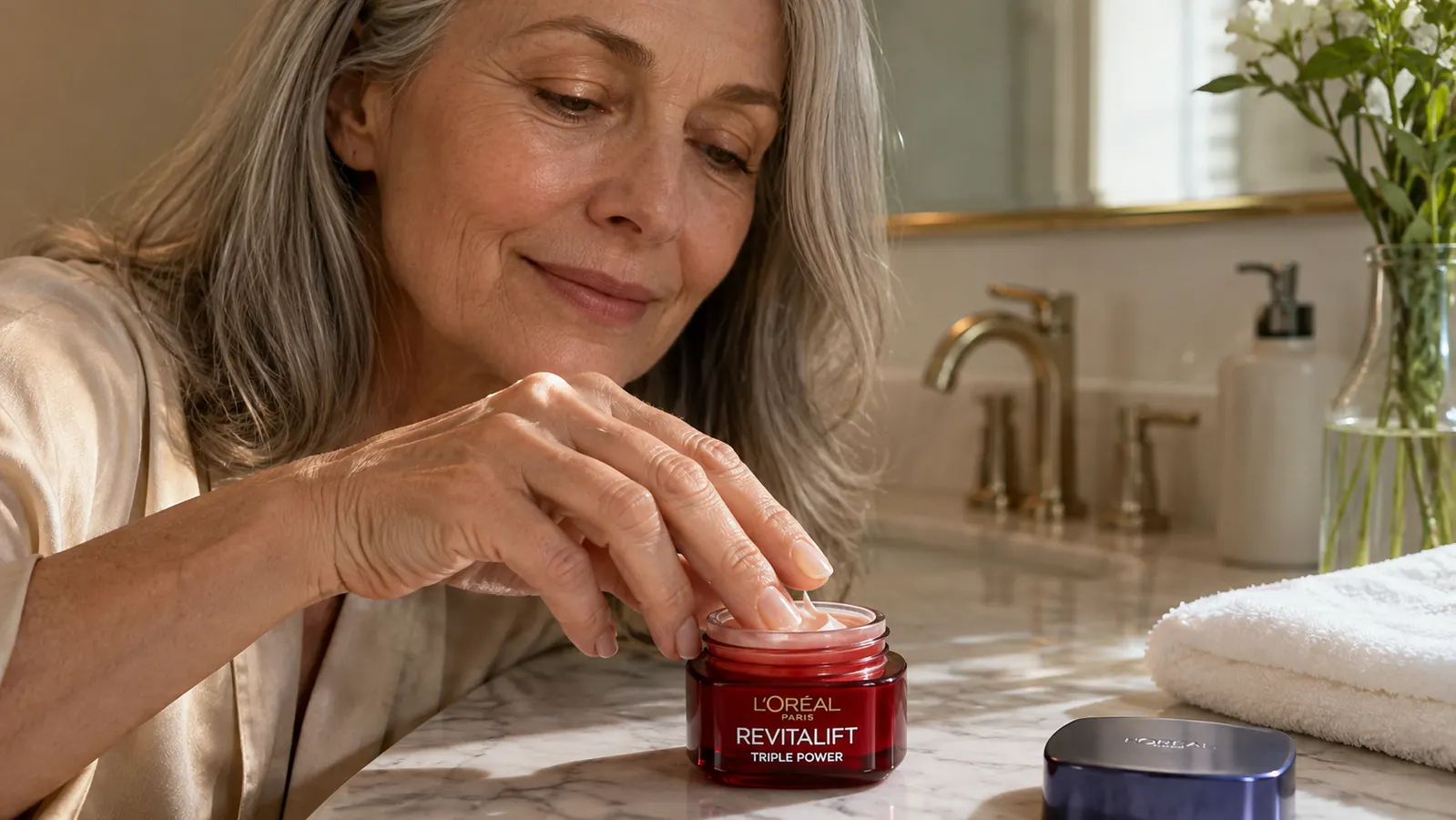
For nine years the jar on my bathroom counter came from the counter at Bloomingdale's, not the drugstore aisle. I bought La Mer the way some women buy a good coat, once a year, wincing a little at checkout, telling myself the crease across my forehead was worth it. Then my dermatologist's office closed for renovations, my usual stop-in became a six-week wait, and I found myself standing in a CVS at nine at night looking for something, anything, before a work trip. L'Oreal Paris Revitalift Triple Power Moisturizer was the jar within reach at eye level. I did not expect to still be reaching for it eleven months later, and I did not expect to write this without a hint of embarrassment.
This is not a results piece, I already wrote that one, the ninety-day breakdown of what changed in my skin week by week is over here if that is what you came for. This is the honest one. The one about whether a jar that costs a fraction of what I used to spend can actually sit where a department-store cream sat, whether the pump-versus-jar question matters as much as people online insist it does, and whether the fragrance is a dealbreaker for a nose that has gotten pickier with age. L'Oreal Revitalift earns its spot on my counter most days. It also has a smell I still haven't fully made peace with, and I want to get to that honestly instead of glossing past it.
The Quick Verdict
A genuinely capable moisturizer that closes most of the gap on the jars three times its size, minus the fragrance restraint and minus the pump.
Amazon Check Today's Price →Curious If the Drugstore Jar Really Holds Up? See What's In It.
L'Oreal Paris Revitalift Triple Power pairs pro-retinol, hyaluronic acid, and vitamin C in one jar, no dermatologist wait required. Here's today's price and the full ingredient list.
Amazon Check Today's Price on Amazon →How I've Actually Used It
I use it exactly once a day, at night, after a plain cleanser and before nothing else. Mornings I still reach for sunscreen and stop there, my skin doesn't want a heavy layer under makeup before ten in the morning. At night, a scoop about the size of a dime covers my whole face and the top of my neck, and I've learned not to be stingy with the jar the way I was taught to ration La Mer. There's simply more product here for less trouble, and treating it like a rationed luxury item undersells what L'Oreal Revitalift is actually meant to do.
Eleven months in, I'm on my fourth jar. I switch jars roughly every two months at a real nightly amount, which tracks with a two point five five ounce container and a dime sized scoop. That's a rhythm I never had with the department-store cream, where a jar sat mostly still on the counter because using enough for real coverage felt wasteful. Consistency, it turns out, mattered more to my skin than concentration ever did.
My hands aren't what they were either. Mild arthritis in both thumbs makes twisting a stiff jar lid a small daily negotiation, and Revitalift's wide, shallow jar with a simple twist cap has been easier on my hands most mornings than the narrower, deeper jar I used before, where getting a full scoop out with two fingers used to take a genuine effort. Winter made this more noticeable than summer ever did, my joints stiffen with the cold, and a jar that opens easily at seven in the morning in January is worth more to me than it would have been at forty-five.
The Department-Store Jar I Used to Buy
I'll name it, because pretending otherwise is its own kind of dishonesty: La Mer's Creme de la Mer was my splurge for nearly a decade. I loved the ritual of it, the small paddle, the way the cream warmed between my palms before I pressed it in. What I didn't love, if I'm being fully honest with myself now, was how much of that ritual was theater. Warming a cream in your palms for thirty seconds before applying it does not change what it does for your skin once it's on.
Side by side, the two jars aren't as far apart as the marketing around each one wants you to believe. Here's how they actually compare, row by row, after months of using both.
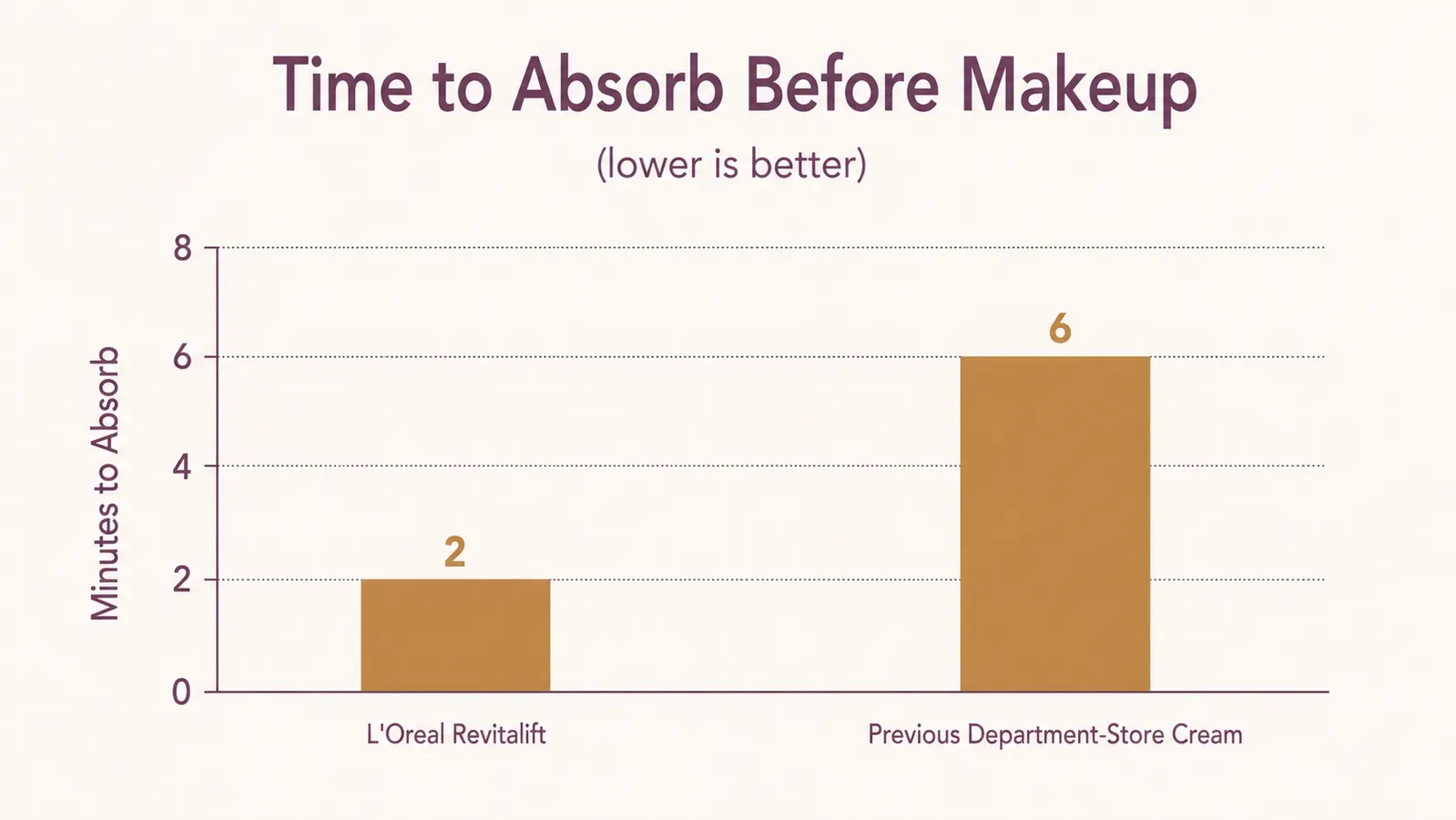
I did spend a stretch running it directly against one of the famous department store jars, and the honest summary is that it splits about evenly. The Revitalift sinks in inside roughly two minutes, so makeup can go on top without a wait, while the luxury jar wants nearer six and really has to be pressed in. A jar of the Revitalift lasts me about two months at a genuinely nightly amount, where the smaller luxury jar empties faster on the same routine, and its ingredient list is printed on the carton in a size I can read without hunting for my glasses.
Where the expensive jar genuinely wins is the feel under makeup. It is silkier, and foundation glides straight over it, where the Revitalift stays slightly tacky for the first few minutes. On two counts they are simply level: both use an open twist-cap jar, so your fingers touch the product either way, and both carry a strong signature fragrance that lingers. If scent bothers you, neither one solves that problem.
Where La Mer genuinely pulls ahead is in how it sits under foundation, silkier, no adjustment period. I miss that on the days I'm dressing up. But for the other twenty-nine days of the month, the difference is not one I could pick out in a blind test, and I've tried.
The cost gap matters too, even without putting a number on it here. A jar of Revitalift runs a small fraction of what a comparable La Mer jar costs, and that gap alone changed how I use skincare day to day. When a cream is expensive enough to feel precious, you use less of it than the label recommends, you save it for special occasions, you let the jar sit half-empty for months out of a strange kind of loyalty. A cheaper jar gets used properly, every night, without the guilt, and a moisturizer that actually gets applied consistently will usually beat one that gets rationed out of anxiety about the cost.
The Ingredient List, Read Slowly
I read labels now in a way I didn't in my thirties, partly out of habit and partly because the print keeps getting smaller and I keep needing my glasses closer. L'Oreal Revitalift's carton spells out its three headline ingredients plainly: pro-retinol, hyaluronic acid, and vitamin C. Pro-retinol is a gentler, slower-converting cousin of the prescription-strength retinoids, meant to support the skin's natural renewal without the redness that stopped me from ever finishing a tretinoin prescription years ago. Hyaluronic acid pulls water into the skin's surface. Vitamin C is there for tone and a measure of environmental defense.
None of that is unique to L'Oreal, the same three ingredients show up across half the moisturizer aisle at every price point, including the one I put head to head against Olay's Regenerist line for anyone weighing two drugstore options instead of a drugstore-versus-department-store question. What L'Oreal does well is put a legible concentration and a legible label right on the outside of the jar, where I can actually read it standing in a store aisle without pulling out my phone.
La Mer's ingredient list, by contrast, is printed in a type size that assumes you already trust the brand enough not to check. I had to photograph it and zoom in on my phone the last time I tried to read it start to finish. That is not a claim about what's inside the jar, it's a claim about what the company is willing to make easy for a customer to verify, and after nine years of buying it without reading it closely, that started to bother me more than I expected.
Jar or Pump: The Question Nobody Asks
Skincare forums argue about pumps versus jars as if it's purely a hygiene question, bacteria on your fingers, air exposure degrading actives. Those concerns are real but overstated for a cream you're using up within a couple of months. The question that actually affects me every morning is a mechanical one: can I get the lid off and a usable scoop out without help. Revitalift's jar has a wide mouth and a lid with real grip texture, which matters more to me at sixty-one than it did at forty.
A pump would still be better. I won't pretend otherwise. A pump keeps my fingers out of the product entirely and doses itself, no guessing at a dime-sized amount with a fingertip that's already a little stiff before coffee. If L'Oreal ever puts Revitalift's exact formula in a pump bottle, I will switch that same week. Until then, a wide jar with an easy lid beats a narrow jar with a hard lid, and it beats a pump only in the sense that a pump isn't actually on the shelf next to it.
For anyone building out a fuller routine around this stage of life rather than picking a single product, the five-step routine I put together covers where a jar like this one fits alongside cleanser, sunscreen, and whatever serum you're already committed to.
The Fragrance Problem
Here's the part I almost didn't finish the jar over. Revitalift has a rose-and-powder scent that is stronger than I expected from the ingredient list, and it lingers for a good ten or fifteen minutes after application, long enough that my husband has asked what perfume I'm wearing before bed. I don't wear perfume before bed. That's the cream.
I've made my peace with it because everything else earns the tradeoff, but I want to say plainly that if you're someone who reacts to fragrance, whose skin gets reactive around scented products, or who simply can't stand a floral note lingering on your pillowcase, this is the one honest reason to look elsewhere before you buy. La Mer has its own strong, distinctive scent too, so switching away from fragrance entirely would have meant leaving both of these jars behind, not just this one.

What It Actually Does, and Doesn't, for Fine Lines
I'm not going to re-litigate the week-by-week tracking here, that's the long-term piece. What I'll say in the honest version is this: the fine lines at the outer corners of my eyes are softer than they were a year ago, not gone, softer. The deeper line across my forehead, the one I bought La Mer hoping to erase for nine straight years, is exactly as present as it was before I switched. Neither cream touched it. I don't think any moisturizer, regardless of what's in the jar or what it costs, was ever going to.
What actually changed was hydration, consistently, day to day, in a way that showed up as less visible texture by midmorning rather than a dramatic before-and-after. That's a modest claim and I mean it as one. If you're hoping a jar of anything, drugstore or department store, will do what a dermatologist's office does, this review isn't going to tell you that, and neither would an honest one about La Mer.
What I can say with more confidence is the comparison that matters to most people reading this: does the drugstore option get you close enough to the expensive one that the difference stops being worth what you're paying for it. For my skin, after eleven months, the answer has been yes, with the fragrance as the one asterisk I'd want anyone to know about before they buy. I no longer feel like I'm settling when I reach for it, which is a bigger shift in how I think about my own routine than I expected a single jar to cause.
What I Liked
- Wide jar and easy-grip lid are genuinely kinder to hands with mild arthritis than most department-store packaging
- Legible ingredient list printed right on the carton, no zooming in required
- Hydration held up consistently at a fraction of what a comparable department-store jar runs
- One jar lasts roughly two months at a real, un-rationed nightly amount
- Absorbs fast enough to layer sunscreen or makeup on top within a couple of minutes
Where It Falls Short
- Fragrance is noticeable and lingers, a real issue for scent-sensitive skin
- Still a jar, not a pump, fingers touch the product every time
- Doesn't touch a deep, static line the way no moisturizer at any price ever really does
- Feel under foundation is slightly tackier than a true luxury cream for the first few minutes
The deeper line across my forehead is exactly as present as it was before I switched. Neither cream touched it, and I don't think either one was ever going to.
Who This Is For
This is for anyone who has been buying a department-store moisturizer more out of habit or loyalty than because they've actually compared it side by side with something simpler. It's for hands that have gotten less patient with stiff packaging, for skin that wants consistent hydration more than it wants a nine-ingredient serum stack, and for anyone willing to trade a little bit of luxury ritual for a jar they'll actually use enough of to matter. It's also for anyone who has caught themselves rationing an expensive cream out of guilt rather than using it the way it was meant to be used.
Who Should Skip It
Skip it if fragrance is a real problem for your skin or your patience, this one does not go unscented. Skip it if you've already found a pump-dispensed cream you love and pump hygiene is non-negotiable for you. And skip it if what you're really chasing is one specific deep, set line disappearing, because in my experience across two very different price points, that's not what a moisturizer, any moisturizer, actually does. If your goal is a specific outcome rather than steady, ordinary maintenance, a conversation with a dermatologist will serve you better than another jar on a shelf.
Still Deciding Between the Drugstore Jar and the One You've Been Buying Out of Habit?
See today's price on L'Oreal Paris Revitalift Triple Power and read the full ingredient list before you decide what's actually worth the extra cost.
Amazon Check Today's Price on Amazon →