

By the time I hit my late fifties, the backs of my hands and the tops of my cheekbones had started keeping a record of every summer I'd spent without a hat. Flat brown patches, some the size of a lentil, some the size of a dime, sitting there whether I wanted them or not. Nobody warns you that decades of ordinary sun exposure add up to visible spots that seem to show up all at once in your sixties, long after the sunburns themselves are forgotten.
A vitamin C serum won't erase that history, but used the right way, morning after morning, it can genuinely fade the look of those spots and even out the skin around them over time. I've been using TruSkin's Brightening Vitamin C Serum in my own routine, and this guide walks through exactly how I apply it, layer it, store it, and how long I actually waited before I saw a difference worth mentioning. One honest note before we start: if a spot is new, changing shape or color, itching, bleeding, or not healing, that's a conversation for your doctor, not a job for any serum. This routine is for garden-variety sun spots and age spots, not for anything that looks or behaves differently than the skin around it.
Most of what people call age spots are flat, evenly colored, and have been sitting in the same place for years without changing. That's the kind of spot a vitamin C serum is built to work on, by gently interrupting the process that keeps discoloration on the surface and encouraging skin to look more even over time. It's not a treatment in the medical sense, and I don't use that word for it. A raised spot, one with texture to it, or one that's noticeably darker or larger than last year isn't something to layer serum onto and hope for the best; that's a spot to have looked at first.
Start With the Serum This Whole Routine Is Built Around
Every step below assumes you're using TruSkin's Brightening Vitamin C Serum, the bottle I keep next to my sink. Check today's price and see if it's in stock before you read on.
Amazon Check Today's Price on Amazon →Step 1: Cleanse and Start With a Dry Face
Every layering routine starts the same way, with a clean face. Wash with a mild, fragrance-free cleanser, rinse with lukewarm water, and pat, don't rub, dry with a soft towel. A vitamin C serum is meant to sit directly on skin, not filter through leftover sunscreen, makeup, or last night's moisturizer, so skipping this step means the serum spends its first few minutes working through a layer of everything else you put on yesterday instead of the skin itself.
I give my face a full minute to air dry before I touch the dropper. TruSkin's serum, like most vitamin C formulas, is water-based and thin, and it spreads unevenly over skin that's still damp from a towel. A dry face also lets you actually see where you're placing it, which matters when you're targeting specific spots on your cheeks or the backs of your hands rather than just moisturizing everywhere at once.
I do this in the morning rather than at night, and that's not just habit. Vitamin C works alongside sunscreen to help skin stand up to the day ahead, so its job makes the most sense at the start of the day rather than the end of it. My evenings are for a heavier moisturizer and, on the nights I use it, retinol instead. Splitting the routine that way keeps each product doing its own job instead of competing for space on the same application.
Step 2: Apply the Serum Before Anything Else Goes On
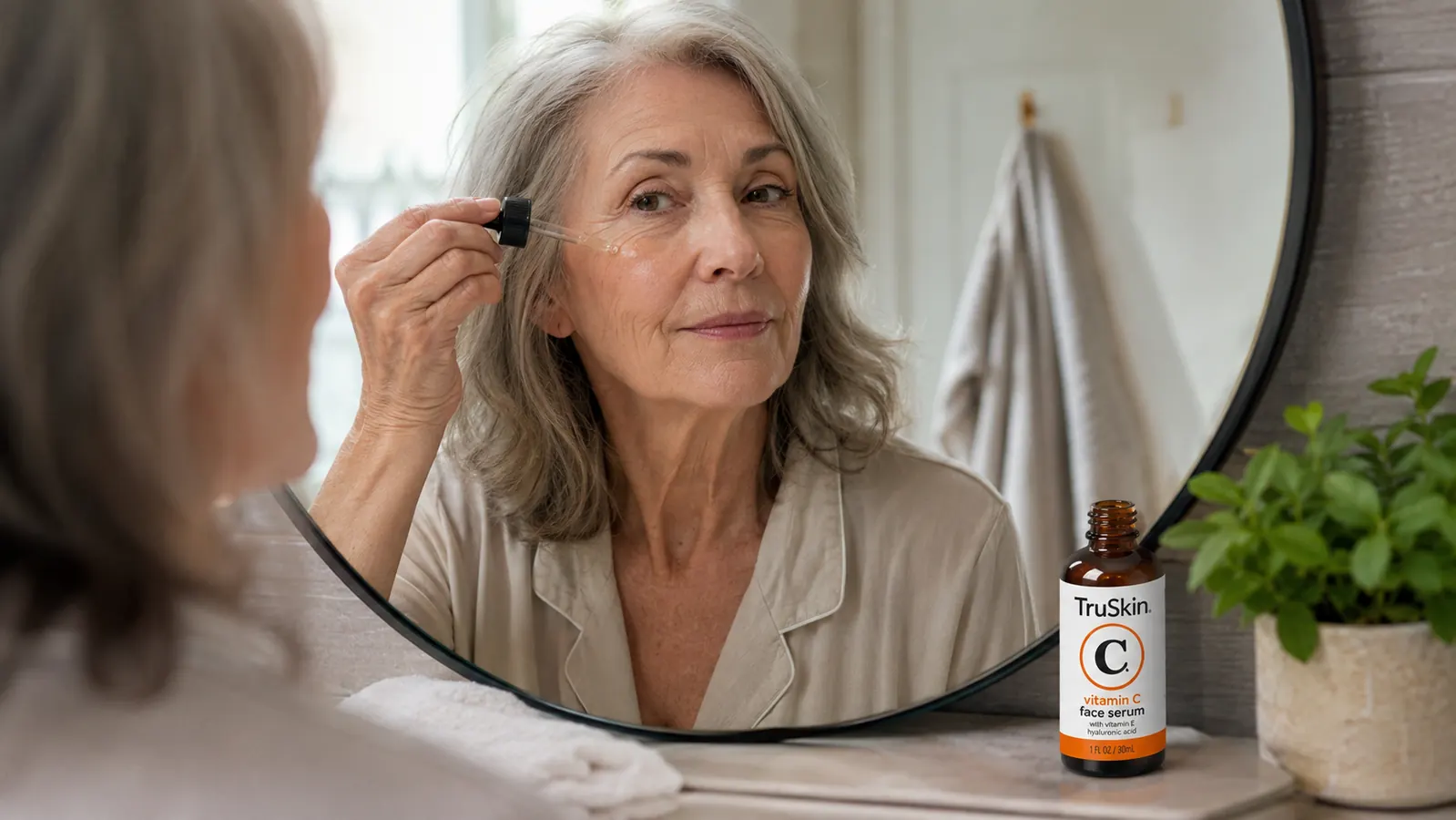
Vitamin C serum goes on first, right after cleansing and before any moisturizer, eye cream, or sunscreen. Two to three drops is enough for the whole face; TruSkin's dropper makes it easy to control that amount without wasting product down the sink. Warm the drops between your fingertips for a few seconds before you apply, then press them into the skin rather than rubbing, starting at the center of the face and working outward toward the jaw and hairline.
Pay extra attention to wherever your own spots have settled, whether that's the tops of your cheekbones, your forehead, or the backs of your hands if you're treating those too. I go over my left cheek, where most of my sun damage sits, a second time before moving on to the rest of my face. Give the serum sixty seconds or so to sink in before you layer anything on top of it; applying moisturizer too quickly can push the serum around instead of letting it settle where you put it.
If your hands carry spots too, don't skip them. I keep a second small amount for the backs of my hands after my face is done, since that skin sees just as much daily sun as anything above the collar and usually gets the least attention. It takes an extra thirty seconds and it's the step I used to forget most often before I started keeping the bottle on the same shelf as my hand cream, as a reminder.
Step 3: Let Sunscreen Follow It Every Single Morning
This is the step people skip, and then wonder why nothing changed. If you're trying to fade the spots that decades of sun exposure caused, and you're not also blocking new sun exposure every single day, you're working against yourself. A vitamin C serum has no meaningful sun protection built into it on its own, no matter what the marketing on some brands implies, and applying it without sunscreen behind it is close to pointless if fading spots is the actual goal.
My order every morning is the same: cleanser, TruSkin vitamin C serum, a lightweight moisturizer, then a broad-spectrum sunscreen of at least SPF 30 as the very last step before makeup. I keep a small bottle of sunscreen right next to the vitamin C serum specifically so I can't do one without seeing the other. If you want the fuller case for why this pairing matters, our rundown of why vitamin C keeps showing up in dermatologist routines covers it, and sun protection is the thread running through nearly all of it.
Sunscreen at the mirror isn't the whole job, either. On the days I'm outside for more than an hour, gardening or walking the neighborhood after breakfast, I reapply around midday and reach for a wide-brimmed hat instead of trusting the morning layer to hold all day. A long sleeve on the drive to appointments protects the backs of my hands more reliably than any serum could on its own, and it costs nothing.

Step 4: Store It So It Doesn't Turn On You
Vitamin C is an unstable ingredient. It reacts to light, air, and heat, and once it does, it stops doing much for your skin even though the bottle looks the same on the outside. The tell is color: a fresh vitamin C serum is usually pale yellow or clear, and if yours has turned a darker amber or brown, or started smelling different than it did when you first opened it, it's oxidized and its job is mostly done, no matter how much product is still left in the bottle.
TruSkin ships its serum in an opaque brown glass bottle, which slows that process down by blocking out light, and I keep mine in the medicine cabinet rather than on the open bathroom counter where morning sun hits it directly. Twist the cap fully closed every time, keep it away from the shower's heat and steam, and buy a bottle size you'll realistically finish within two to three months. A serum sitting half-used for eight months on a sunny windowsill isn't doing the job the label promises, however good it smelled the day you bought it.
Step 5: Give It a Real Timeline Before You Judge It
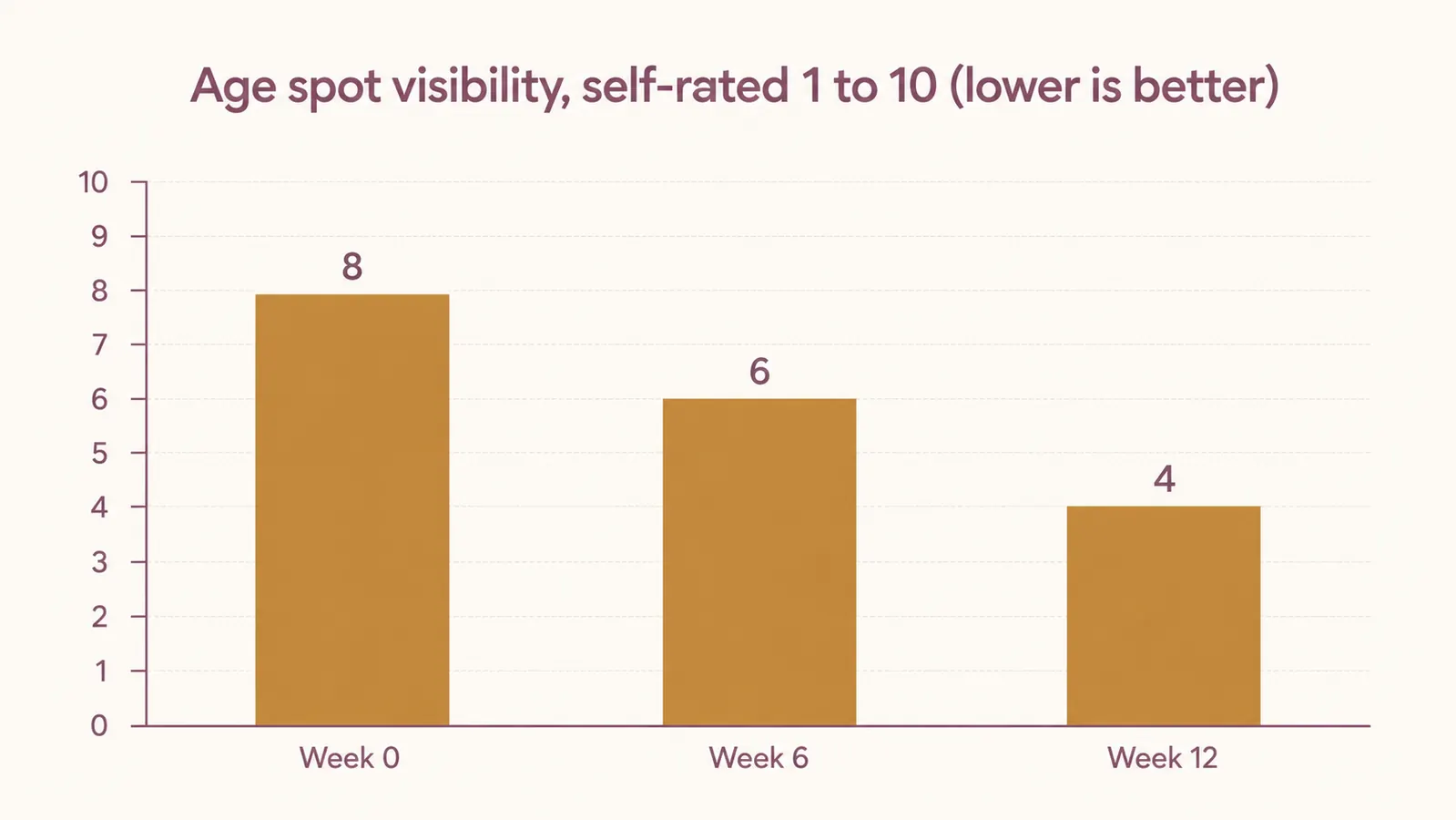
Vitamin C serum is not a fast fix, and anyone promising visible spot fading in a week is selling something. In my own use, the first two to three weeks mostly brought a brighter, more even look to my overall skin tone, nothing dramatic around the spots themselves yet. Using a simple one-to-ten visibility scale I kept in a notes app, ten being impossible to miss and one being invisible, my spots started at an 8. By week six of daily use, that dropped to a 6, the edges softening and looking less sharply defined against the surrounding skin. It wasn't until closer to week twelve, when the score had settled around a 4, that I'd call the change genuinely noticeable to someone who wasn't looking as closely as I was.
Consistency matters more than concentration or price here. A serum used five mornings out of seven, with gaps whenever life gets busy, works slower and less reliably than the same serum used every single day without exception. I've written more about my own three months with this exact bottle in our full long-term review, including what changed on that timeline and what honestly didn't.
Past twelve weeks, don't expect the fading to keep moving at the same pace. Mine has more or less plateaued since, holding steady rather than improving every month. That's a maintenance phase, not a stall, and it's the point where the routine stops being an experiment and becomes part of getting ready in the morning, same as brushing your teeth. It's worth saying plainly what this will not do: a deep, longstanding spot may soften and lighten at the edges without ever fully matching the surrounding skin, and that's a realistic outcome, not a failure.
What the First Two Weeks Actually Feel Like
The first few mornings, a little tingling right after you apply is common, especially if this is the first acid-forward serum in your routine. It should ease off within a minute or two and shouldn't leave lasting redness. I did a patch test on the inside of my forearm twenty-four hours before I ever put TruSkin's serum on my face, worth doing if your skin has reacted to actives before. Nothing dramatic happens visually in these first two weeks; spots don't move yet. What you're more likely to notice is that your overall skin tone looks a shade brighter and less flat by the end of week one, the earliest honest sign the routine is doing something.
If tingling turns into real stinging, or your skin flushes red and stays that way, stop for a day and rinse with cool water rather than pushing through out of stubbornness. When I go back to it, I use it every other morning for the first week instead of daily, then move to daily once skin has adjusted. That slower start saved me a week of irritated, flaky skin the first time I tried a vitamin C serum, years ago, before I knew better.
Mistakes That Slow This Down
The most common mistake I see, and the one I made myself early on, is using more serum than the bottle is built for, on the theory that more must work faster. It doesn't. Extra product mostly runs off, gets wasted, or sits on the surface long enough to irritate skin that's already trying to adjust. A close second is skipping the patch test entirely on the assumption that a serum that worked fine for someone else's skin will behave the same way on yours, which isn't a safe bet once skin has become more reactive with age.
The other mistake is layering it against the wrong things. Vitamin C doesn't pair well with benzoyl peroxide or a strong chemical exfoliant in the same session; move an exfoliating acid to a different time of day, or a different day, rather than stacking it directly on top. Give at least a few minutes before layering anything else over it. And don't buy a bottle larger than you'll use in two to three months to save on price; a half-finished bottle of TruSkin sitting past its prime does less for your skin than a smaller one you actually finish while fresh.
What Else Helps
A few things make this routine work better without complicating it. Gentle exfoliation once or twice a week, whether that's a mild chemical exfoliant or just a soft washcloth, helps clear away the dulled surface cells sitting on top of the spots you're trying to fade. Keep your hydration and moisturizing steps consistent too; skin that's dry and irritated shows every change more slowly than skin that's comfortable and balanced.
Go easy on stacking other active ingredients, like retinol, into the same morning routine as vitamin C. Using both is fine for many people, but doing it wrong can leave skin irritated rather than brighter, so if you're introducing retinol too, keep it to evenings and give your skin a break from doing everything at once. And keep your expectations honest going in: I cover what I didn't love about the texture and scent in our honest review of this serum, and it's worth reading before you build a whole routine around any one bottle.
The spots didn't disappear. They faded enough that I stopped noticing them in the mirror, and that was the actual goal all along.
The Serum This Whole Routine Is Built Around
If you're ready to start, TruSkin's Brightening Vitamin C Serum is the bottle I've been using every morning since this routine began. Check today's price on Amazon before you build the rest of your routine around it.
Amazon Check Today's Price on Amazon →